

Fawtara-ready e-invoicing, before Oman's 2027 deadline
Sumu makes your business Fawtara-ready — structured e-invoices exchanged over the PEPPOL network and reported to the Oman Tax Authority, connected straight to the systems you already use.


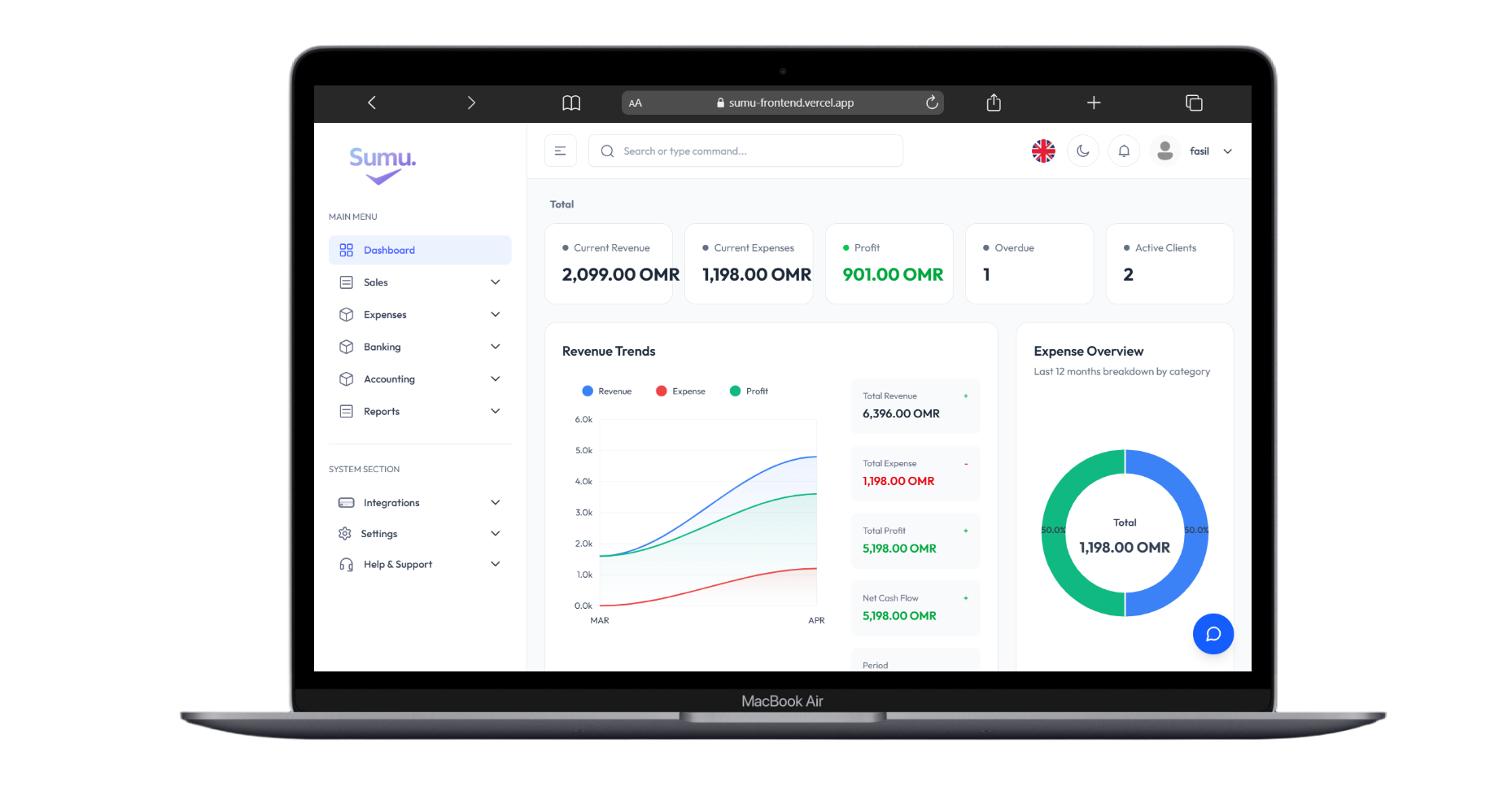


Is your business ready for Oman's e-invoicing mandate?
The mandate becomes compulsory on 1 April 2027 for businesses with annual taxable supplies above OMR 5 million, and on 1 October 2027 for all remaining VAT-registered businesses. Sumu takes you from readiness assessment and ERP integration through to go-live and ongoing support.
 Fawtara E-Invoicing Certified
In 2027, PDFs stop counting as valid tax invoices in Oman.
Oman is rolling out national e-invoicing through Fawtara, the Oman Tax Authority's official platform. Invoices move to structured XML on the PEPPOL six-corner network, exchanged through OTA-accredited service providers using the PINT OM standard. Sumu handles that shift for you — so nothing breaks in how your team already bills.
99.9%Uptime
98%Customer Satisfaction

Everything you need to issue, exchange, and archive compliant e-invoices.
One platform built around Oman's Fawtara requirements — generate structured invoices, validate them before they go out, deliver them over PEPPOL, and keep every document archived and audit-ready.
Compliance
- Structured XML (PINT OM / UBL 2.1)
- PEPPOL six-corner delivery
- OTA tax data reporting
60%
Validate before you submit
Every invoice runs through PINT OM schema and business-rule checks before it reaches OTA — so what you send is accepted the first time, not bounced back for rework.


Delivered over PEPPOL
Sumu routes each invoice through the PEPPOL six-corner network to your buyer's access point and reports it to the Oman Tax Authority in the same step — no manual submission, no separate filing.


Archived and audit-ready
Every e-invoice and tax data document is retained for the full statutory period — 10 years in general, 15 years for real estate — so you're covered if OTA ever asks to see it.

Fawtara-ready without disrupting how you work.
Getting compliant shouldn't mean rebuilding your finance stack. Sumu sits between your existing systems and the Oman Tax Authority, handling the technical requirements so your team can keep billing the way it always has.
- Keeps your existing ERP, accounting, or POS system in place.
- ISO/IEC 27001:2022 certified, with end-to-end encryption.
- Real-time validation catches errors before OTA rejects them.
- Oman-based team supporting you in Arabic and English.
Build directly on the Sumu API
Every core flow — onboarding, sending, tracking, downloads — is one HTTP call away. If your team can call a REST endpoint, you can integrate today.
{
  "sender_id": "e53b01a6-e15a-46e8-…",
  "invoice_number": "INV-2026-0142",
  "invoice_currency_code": "OMR",
  "buyer": { "name": "…", "vat_number": "…" },
  "items": [ { "item_name": "…", "quantity": 1 } ]
}{ "status": "queued", "transaction_id": "58b18ced-…" }- Taxpayer onboarding & Peppol registration
- Invoice creation, validation & tracking
- Webhooks for every status change
- XML, PDF & tax-document downloads
Connect the tools you already run
Direct connectors for the accounting and ERP platforms Omani businesses already run — on the way.





Building your own connector in the meantime? The same API these will run on is live today.
See Sumu's E-Invoicing in Action
Sumu helps you issue, track, and stay compliant with e-invoicing across Oman and the GCC — all from one simple platform. Book a personalized demo and see how quickly your business can go paperless.
Certified Security. Accredited Compliance.
Sumu is backed by internationally recognized standards and official accreditation, so you can trust us with your business's financial data and e-invoicing compliance.




Oman e-invoicing: common questions
Straight answers about the Fawtara mandate, what it means for your business, and where Sumu fits in.
Fawtara is the Oman Tax Authority's national e-invoicing program, built on the Peppol network. The binding e-invoicing obligation comes from Tax Authority Decision No. 189/2026; record-retention rules come from Royal Decree No. 121/2020, Oman's VAT Law. It governs how e-invoices are issued, exchanged, and reported in Oman. It applies to VAT-registered businesses, phased in by annual taxable supplies — businesses above OMR 5 million move first, and the rest follow six months later.
Phase 1 becomes mandatory on 1 April 2027 for businesses with annual taxable supplies of OMR 5 million or more. Phase 2 follows on 1 October 2027 for all remaining VAT-registered businesses — the phase that covers most SMEs. There's no separate pilot phase to plan around before these dates.
No. Sumu connects to the ERP, accounting, or POS system you already use, so your team keeps billing the way it always has. Sumu handles the structured XML generation (PINT OM / UBL 2.1), PEPPOL six-corner delivery, and OTA reporting behind the scenes.
Yes. Sumu is ISO/IEC 27001:2022 certified and uses end-to-end encryption to protect your data in transit and at rest, with regular third-party security audits and hourly backups to redundant cloud infrastructure. We never share your financial information with third parties, and every e-invoice is retained for Oman's full statutory archiving period.

Ready to grow with Sumu?
Contact Sales | Contact Support | Careers. Join us to transform businesses in Oman and across MENA, and explore our Blogs and Partnerships.
No credit card required
14-Day free trial